Twitter Updates

    follow me on Twitter

    Monday, October 27, 2008

    Rality Check: Global Health Challenges

    Thought-provoking...

    g

    -------
    Lets admit it, we have a serious global health problem Print E-mail
    Written by Margaret Chan
    Image
    Margaret Chan
    October 24, 2008:
    Under the influence of globalisation, the landscape of public health has changed in profound and almost universal ways.

    Differences between rich and poor countries are no longer so clear. More developing countries now have pockets of wealth that attract the lion’s share of spending on health.

    More wealthy countries have growing urban slums and shanty-towns that drain health resources and strain the social welfare systems. There is something wrong.

    Gaps in health outcomes are not matters of fate. They are markers of policy failure.

    As I have mentioned, globalisation has its bright and its dark sides.

    But here is the problem: globalisation has no rules that guarantee the fair or balanced distribution of benefits.

    I believe that our world is out of balance in matters of health as never before. This should not be the case.

    Health is the very foundation of economic productivity and prosperity. Balanced health status within a population contributes to social cohesion and stability.

    Social justice

    A world that is greatly out of balance in matters of health is neither stable nor secure. This world will not become a fair place for health all by itself.
    Health systems will not automatically gravitate towards greater fairness and efficiency.

    Nor will globalisation self regulate in ways that favour fairness in the distribution of benefits. Deliberate policy decisions are needed in all these areas.

    I believe there is no sector better placed than health to insist on equity and social justice.

    No one should be denied access to life-saving or health-promoting interventions for unfair reasons. Equity in access to health care comes to the fore as a way of holding globalisation accountable.

    The policies governing the international systems that link us all so closely together need to have more foresight. They need to look beyond financial gains, benefits for trade, and economic growth for its own sake.

    They need to be put to the true test. What impact do they have on poverty, misery, and ill health – in other words, the progress of a civilized world?

    Do they contribute to greater fairness in the distribution of benefits? Or are they leaving this world more and more out of balance?

    If history repeats itself, cant we learn from the past and avoid repeating mistakes? There is too much at stake in our turbulent world to make the same mistakes yet again.

    Chan is the director-general of WHO.

    Factors Affecting Choice of OTC Health Product

    ----
    Nielsen: U.S. Health Care Consumers Place More Importance on Price and Value When Choosing Over-the-Counter Products Compared to Global Consumers

    U.S. Consumers Highly Rank Effectiveness, Safety and Confidence in the Product When Choosing Over-the-Counter Medication


    Last update: 11:00 a.m. EDT Oct. 27, 2008

    SCHAUMBURG, Ill., Oct 27, 2008 (BUSINESS WIRE) -- An added sign of a battered U.S. economy, U.S. consumers place more importance on price and value when choosing over-the-counter (OTC) medication compared to global consumers, according to a global online survey conducted by The Nielsen Company in partnership with the Association of the European Self-Medication Industry (AESGP).

    Thirty percent of U.S. consumers consider price important when choosing OTC products, while on average, only 17 percent of global consumers do. Only Japanese consumers place more importance on price (33 percent). One quarter of Americans consider whether the product is a good value for money, while on average, 15 percent of global consumers make this a consideration.

    "With increasing medical costs and a fragile economy, the U.S. consumer is more price and value centric than ever," said Matt Dumas, managing director, NielsenHealth. "These findings highlight the rising importance of generic drugs in the U.S. market, which is underscored by low OTC product loyalty scores versus global markets. Branded OTC manufacturers need to ensure they develop and invest in their brands instead of simply focusing on the efficacy of their products in order to vie in such a competitive price-driven environment."

    Nielsen's research shows that product loyalty is more important in other parts of the world. Twelve percent of U.S. consumers consider whether the product is one that they usually use, while nearly one quarter (23 percent) of global consumers do. And, only seven percent of U.S. consumers consider whether or not the product is recognizable as important, compared to sixteen percent of global consumers.

    Tell Me It Works

    When choosing OTC medication, U.S. consumers rank the product's effectiveness, safety and whether or not they have confidence in the product as most important. According to Nielsen's research, fifty percent of U.S. consumers ranked "I know it works" as an important factor when choosing OTC medication, while four out of ten (42 percent) U.S. consumers cited "I know it is safe" and 35 percent responded that having confidence in the product were important. Least important to U.S. consumers are recognizable products (7 percent), easy to take products (8 percent) and choosing products because it is usually used (12 percent).

    "With a highly competitive OTC marketplace in the U.S., a product's effectiveness is the driving factor behind consumer preference," said David Parma, global head of Nielsen Consumer Research. "Safety clearly is top of mind, particularly now with the recent intervention by the FDA in prescription and OTC medication. OTC manufacturers need to do a really good job of communicating the safety of their products in light of this."

    Additional Findings

    Other key findings include:
    -- When feeling the first signs of a minor ailment, 60 percent of U.S. consumers usually wait to see if it gets better before taking medicine. Twenty-five percent usually take medicine as soon as they start to feel unwell, while only nine percent always take medicine as soon as they start to feel ill.
    -- Of those consumers that usually wait to see if they get better or never take medicine, 34 percent respond that the main reason they do not take medicine is because taking medicines can be harmful to your health. Fourteen percent indicate that they do not take medicine because medicines are too expensive.
    -- When asked what would help them take care of their health and minor ailments, U.S. consumers indicated more advice or support from their doctors (44 percent), clearer information on and in the pack of medicine (36 percent) and more health education (33 percent).
    -- Forty-nine percent of U.S. consumers strongly agree or agree that more medicines should be available without a prescription from the doctor. Thirty-one percent strongly disagree or disagree, while thirty-one percent don't have an opinion or don't know.

    About the Survey

    The Nielsen Global Online Consumer Survey, conducted by Nielsen Consumer Research, was conducted in April and May 2008 among 28,253 Internet users in 51 markets in Europe, Asia Pacific, North America and the Middle East. The largest half-yearly survey of its kind, the Nielsen Global Online Consumer Confidence and Opinion Survey provides insight into current confidence levels, spending habits/intentions and the major concerns of consumers across the globe.

    About The Nielsen Company

    The Nielsen Company is a global information and media company with leading marketing and consumer information, television and other media measurement, online intelligence, mobile measurement, trade shows and business publications (Billboard, The Hollywood Reporter, Adweek). The privately held company is active in more than 100 countries, with headquarters in New York, USA. For more information, please visit, www.nielsen.com.

    SOURCE: The Nielsen Company
    The Nielsen Company
    Jennifer Frighetto, (847) 605-5686
    jennifer.frighetto@nielsen.com

    Copyright Business Wire 2008 End of Story

    US Presidential Candidates' Healthcare Plans...

    Worth a read...

    g

    -------

    U.S. Presidential Candidates' Health Care Plans Update: A Side-by-Side Comparison


    By: Susan J. Blumenthal, M.D., M.P.A., Yi-An Ko, Elizabeth M. Moore, and Erica L. Cook*

    With the 2008 Presidential election less than a week away and the devastating impact of the current financial crisis on Main Street and Wall Street, health care must be high on the list of top priorities for America's next Chief Executive to address. The next President of the United States will confront major health policy decisions that will affect the lives of all Americans. Despite spending over $2.4 trillion a year on health care -- 18% of the U.S. GDP and twice as much as any other nation -- the United States ranks only 42nd in life expectancy and 37th in a World Health Organization study on the performance of national health systems. Alarmingly, the United States also has the highest infant and maternal mortality rate in the industrialized world (important indicators of a nation's health status and the quality of its medical system) and Americans receive the right treatment for health conditions only 55% of the time. The U.S. Federal government currently spends more on health care than on Social Security and national defense combined, the next most expensive items, but Americans get the right treatment only 55% of the time. Expenditures on health care in the United States -- already the highest per person in the world -- are predicted to nearly double by 2017, to $4.3 trillion, or 20% of GDP. That means, if this trajectory is not altered, in less than a decade, 20 cents out of every dollar of America's budget will be spent on health care. Currently, more than 75% of health care dollars are spent on patients with chronic diseases, yet an estimated 70% of all chronic diseases are caused by preventable factors, such as smoking, obesity, and physical inactivity. But despite these statistics, less than 5 cents of every health care dollar supports prevention and public health. Furthermore, global health concerns, including AIDS, TB, malaria and the chronic disease pandemic, have humanitarian, economic and national security implications for the United States.

    The next President of the United States will also decide whether to increase our national investment in scientific research, which is the foundation for effective public health and medical interventions, the engine of societal progress, and a cornerstone of innovation for the American economy. Over the past several years, significant reductions in funding -- more than 18% in 2008 (in inflation-adjusted dollars) at the NIH alone -- as well as limitations on types of studies conducted, such as stem cell research, have had a significant impact on the way researchers work, laboratories operate, and universities hire. These reductions are endangering efforts to advance the frontiers of knowledge, to find cures and prevention strategies for the diseases that affect American families, to cultivate the next generation of scientists, and to foster entrepreneurship in the United States including the establishment of new health-related businesses and product opportunities.

    Alarmingly, the effects of significant decreases in the purchasing power of funding in recent years for biomedical research are coming at a time of escalating threats to human health. The prevalence of chronic diseases such as heart disease, cancer, Alzheimer's, and diabetes is increasing at an alarming rate, and over 39 new deadly infectious diseases including AIDS, now a global pandemic, have emerged worldwide since the 1970s. Moreover, living in an interconnected global society in which two million people cross national borders each day, infectious illnesses such as avian flu, SARS, AIDS, West Nile virus and the threat of bioterrorism are just a jet plane away. In fact, the controversy last year surrounding the globe-trotting American patient infected with drug-resistant tuberculosis dramatically highlighted not only the vulnerabilities in the public health and national security systems of the United States, but also underscored the urgent need for greater research investments on diseases that may seem to be worlds away.

    While many Americans feel uninformed about the views of their elected officials on scientific, medical, and health research, most seem to understand the importance of providing necessary funds for medical studies. A poll conducted by Research!America in February 2007 found that the vast majority of people in the United States believe that science is very important to our health (86%) and competitiveness (78%) as a nation. Sixty-nine percent of Americans believe that scientific research is critical to our economy, 97% of Americans think it is important for the United States to be a global leader in scientific research, and 91% believe that it is essential in eliminating diseases, such as cancer. It is not surprising, then, that 83% of those polled in a 2006 survey indicated that they were more likely to vote for a candidate who supported increased funding "to find cures for and to prevent disease".

    With our current sick care system, Americans cannot afford -- socially, politically, economically, or otherwise -- to remain on the sidelines. We have a window of opportunity to establish a real health care system with the upcoming 2008 presidential election. While there is a general consensus between Senator McCain and Senator Obama about the importance of reducing health care costs, expanding insurance coverage, strengthening scientific and comparative effectiveness research, and underscoring the power of disease prevention and chronic disease management, their strategies and methods are starkly different on how to best accomplish these goals.

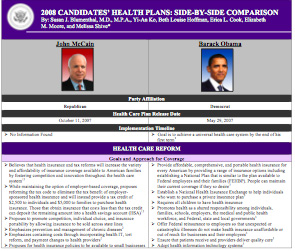
    This article provides a comprehensive side-by-side comparison, in chart form, of the Presidential candidates' health care plans based on information provided on their websites (much of it in their own words) as well as from interviews and statements they have made to the press and in the debates. The updated charts below include a review of the Presidential candidates' proposals including their strategies to increase access to quality health care, combat specific illnesses including HIV/AIDS and cancer, foster scientific and medical research and improve global health. With so much at stake this election year, when voting on November 4th, consider which candidate will write a prescription as President to heal both our nation's sick care system and economy to ensure a healthier and more prosperous future for us all.

    Click on the thumbnail chart for a full PDF.


    U.S. Presidential Candidates' Health Care Plans Side-by-Side Comparison
    2008-10-27-healthcaresnapshot.jpg

    * Rear Admiral Susan Blumenthal, M.D. (ret.) is the Director of the Health and Medicine Program at the Center for the Study of the Presidency in Washington, D.C. and a Clinical Professor at Georgetown and Tufts University Schools of Medicine. For more than 20 years, Dr. Blumenthal served in health leadership positions in the Federal government, including as Assistant Surgeon General of the United States and the first Deputy Assistant Secretary of Women's Health in the U.S. Department of Health and Human Services, as a White House Advisor on Health, and as Chief of the Behavioral Medicine and Basic Prevention Research Branch at the National Institutes of Health.

    Yi-An Ko, a graduate of Harvard University, serves as Special Assistant to Dr. Blumenthal and was a Health Policy Fellow at the Center for the Study of the Presidency in Washington DC.

    Elizabeth M. Moore, a senior at Harvard University, served as a Health Policy Fellow at the Center for the Study of the Presidency in Washington DC.

    Erica L. Cook, a 2nd-year Health Policy and Administration graduate student at Yale School of Public Health, served as Health Policy Fellow at the Center for the Study of the Presidency in Washington DC.

    Half of All Deaths Occur in Under 60s

    Interesting...

    g

    ----------
    WHO: People Under Age 60 Account For Half of Global Deaths


    27 October 2008

    Schlein Report - Download (MP3) audio clip
    Schlein Report - Listen (MP3) audio clip

    A Young HIV positive orphan lies in his cot at the Nyumbani children home, a hospice for AIDS orphans in Nairobi, Kenya
    A Young HIV positive child at a hospice for AIDS orphans in Nairobi, Kenya (file)
    A World Health Organization study finds half of all deaths in Africa are children under 15, and people under age 60 account for half of all deaths around the world. Lisa Schlein reports for VOA from WHO headquarters in Geneva on the latest assessment of the Global Burden of Disease.


    The World Health Organization reports 59 million people died in 2004, including 10 million children.

    According to Colin Mathers, Coordinator for Epidemiology and Burden of Disease at WHO and lead author of the study, there are striking differences among regions.

    "Africa stands out," said Mathers. The burden of disease, premature mortality is twice as high as for other developing regions in the world. And a substantial component of that burden is because of the high levels of child mortality in Africa compared to other regions. Half of all deaths in Africa are children under age 15 to compare with high income countries where one percent of deaths are children under 15 - a huge difference."

    Mathers says four out of the top 10 causes of death globally are infectious diseases.

    The report outlines the leading causes of death globally as heart disease, stroke, pneumonia, chronic respiratory disease, diarrhea, HIV/AIDS and tuberculosis.

    The study goes on to say that men between the ages of 15 and 60 have much higher risks of dying than women in the same age category in every region of the world. It notes this is mainly due to higher levels of heart disease and injuries, including those from violence and conflict.

    While the Middle East comprises only eight percent of the world's population, the report says it accounts for 55 percent of the world's war deaths.

    In Eastern Europe, the risk of death among men under age 60 is higher than in any other region apart from Africa. The study says these early deaths are largely due to cardiovascular diseases and injuries, although accidental poisoning from excess alcohol is a contributing cause.

    Mathers says the report projects tobacco consumption will be responsible for 10 percent of deaths worldwide by 2030. But, he says, deaths from AIDS may decline.

    "The update builds in the revisions to HIV mortality and more optimistic projections of HIV deaths that UNAIDED and WHO have produced which suggest that the epidemic may have peaked, or will peak in the next five years or so, and then AIDS deaths will start to decline," said Mathers.

    The report predicts the proportion of deaths due to non-communicable diseases will rise from 60 percent to 75 percent by 2030. It calls this a sign of success and says people will be living longer. For that reason, they will increasingly be dying from cancers and heart disease rather than from infectious diseases at an earlier age.